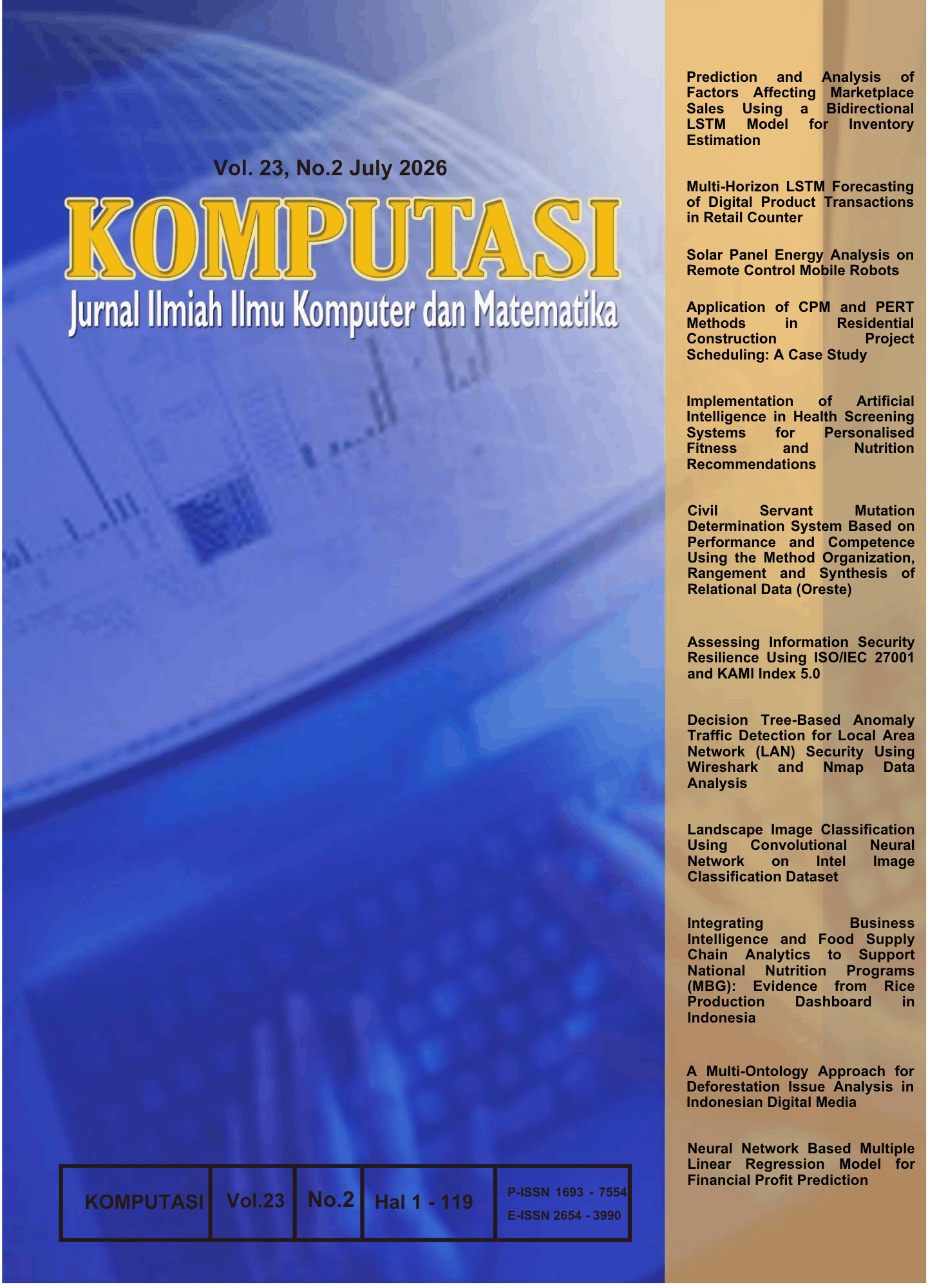
Application of CPM and PERT Methods in Residential Construction Project Scheduling: A Case Study
DOI:
https://doi.org/10.33751/komputasi.v23i2.101Abstract
This study aims to analyze and optimize the scheduling of a residential construction project using the CPM, crashing techniques, and the PERT. A quantitative approach is employed by utilizing data obtained from observations and interviews conducted on a housing construction project in Bandar District, Simalungun Regency. CPM analysis is used to identify the critical path and determine the project duration, while crashing techniques are applied to obtain acceleration alternatives by considering additional costs. Furthermore, the PERT method is used to analyze uncertainty in project duration and to calculate the probability of project completion. The results show that the project duration under normal conditions is 59 days, with the critical path identified as A–B–D–E–G–H–J–O–P. After applying crashing, the project duration is reduced to 55 days with an additional cost of IDR 212,500. The PERT analysis indicates that the expected project duration is 44 days, with a completion probability of approximately 99% for a target duration of 49 days. These findings demonstrate that the combination of CPM, crashing, and PERT methods is effective in improving time and cost efficiency, while also providing a more reliable basis for decision-making under conditions of uncertainty.
Downloads
Published
How to Cite
Issue
Section
License
Copyright (c) 2026 Komputasi: Jurnal Ilmiah Ilmu Komputer dan Matematika

This work is licensed under a Creative Commons Attribution-NonCommercial-ShareAlike 4.0 International License.