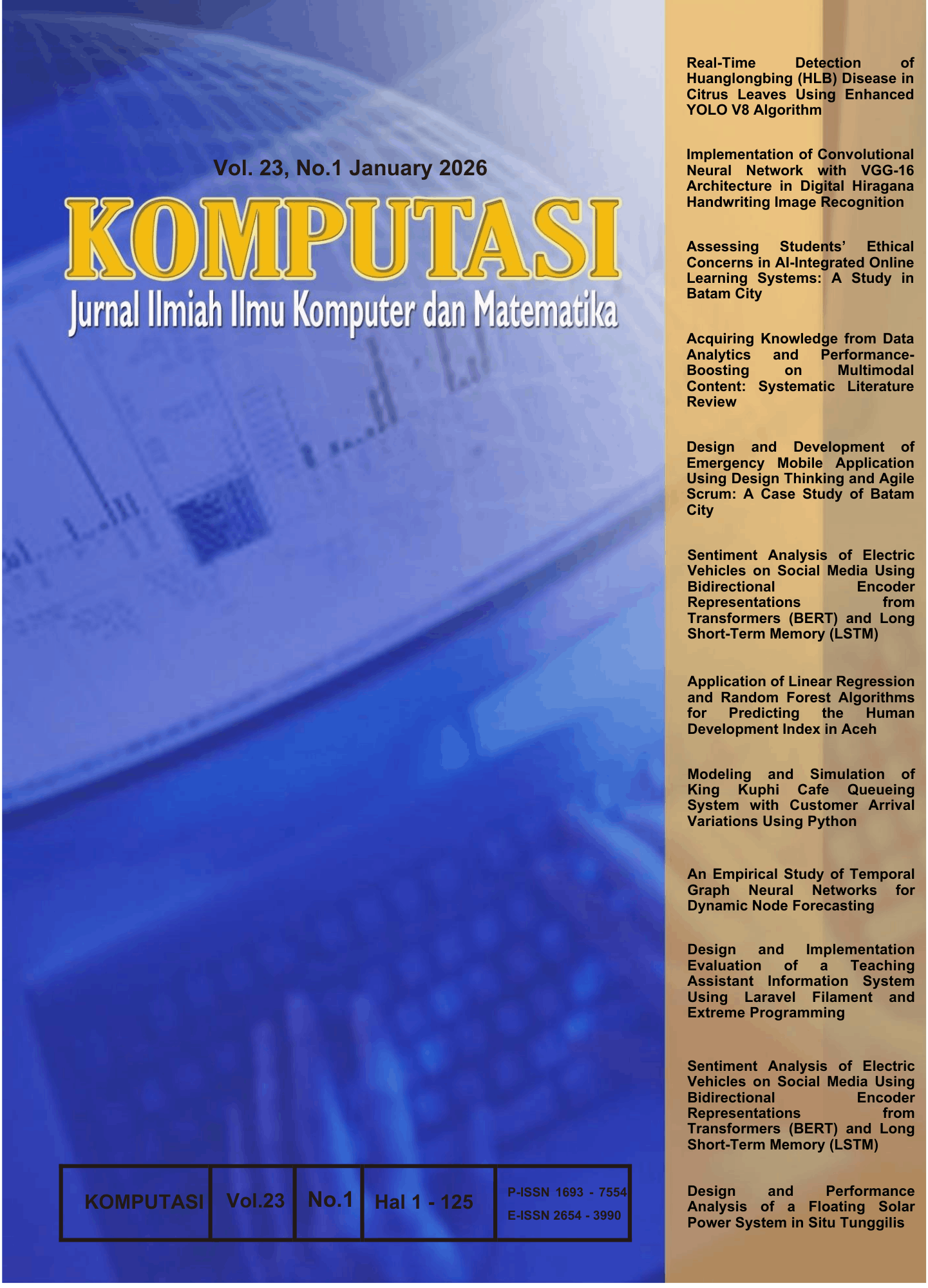
Sentiment Analysis of Electric Vehicles on Social Media Using Bidirectional Encoder Representations from Transformers (BERT) and Long Short-Term Memory (LSTM)
BERT, LSTM, Sentiment Analysis, Electric Vehicles , Social Media
DOI:
https://doi.org/10.33751/komputasi.v23i1.88Abstrak
Electric vehicles (EVs) are widely recognized as an environmentally sustainable alternative capable of reducing greenhouse gas emissions; however, their adoption in Indonesia remains limited. Data from the Indonesian Ministry of Transportation, as recorded in the Type Approval Registration System (SRUT), indicate that approximately 195,084 Battery Electric Vehicles (BEVs) were registered nationwide by early 2024. This study investigates public sentiment toward electric vehicles using social media data from X, Instagram, and TikTok, while also comparing the effectiveness of two text classification approaches: Bidirectional Encoder Representations from Transformers (BERT) and Long Short-Term Memory (LSTM). A total of 5,172 Indonesian-language comments were collected through crawling and scraping techniques using electricvehicle-related keywords over the period January 2021 to January 2025. The comments were categorized into five sentiment classes: very positive, positive, neutral, negative, and very negative. The analytical process followed the Knowledge Discovery in Databases (KDD) framework, including data preprocessing, transformation, classification, and evaluation using a confusion matrix. The results indicate that IndoBERT substantially outperformed LSTM, achieving an accuracy of 91% compared to 36% for LSTM. Sentiment analysis reveals a dominance of negative and very negative opinions, primarily reflecting public concerns regarding cost, performance, and maintenance of electric vehicles. These findings offer important insights for policymakers and the automotive industry in designing targeted promotion strategies, improving public awareness, and strengthening supporting infrastructure. Future research is encouraged to explore data augmentation techniques to improve model performance, particularly for deep learning models such as LSTM, in order to better support evidence-based electric vehicle adoption policies.
Unduhan
Diterbitkan
Cara Mengutip
Terbitan
Bagian
Lisensi
Hak Cipta (c) 2026 Komputasi: Jurnal Ilmiah Ilmu Komputer dan Matematika

Artikel ini berlisensiCreative Commons Attribution-NonCommercial-ShareAlike 4.0 International License.