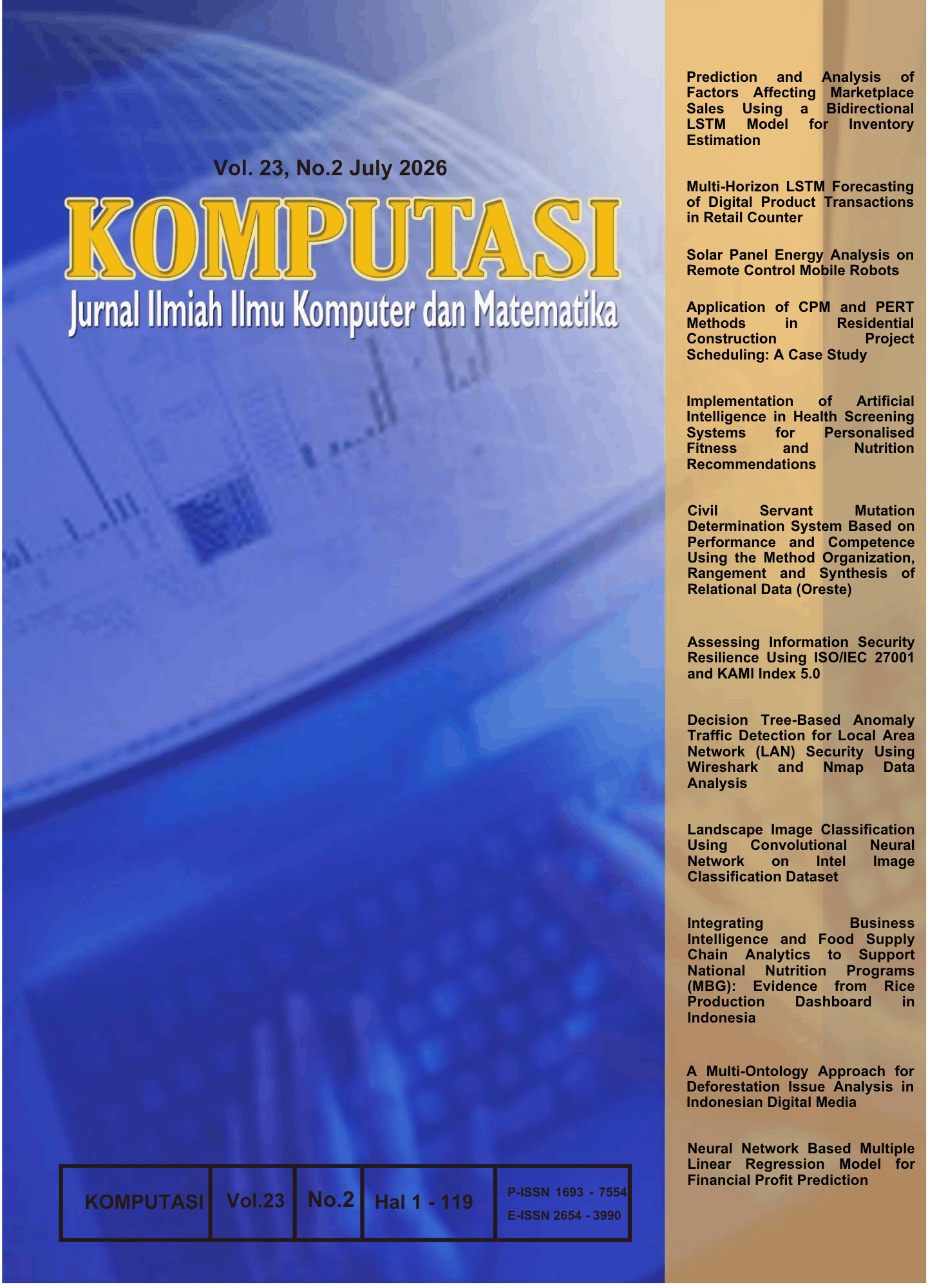
Prediction and Analysis of Factors Affecting Marketplace Sales Using a Bidirectional LSTM Model for Inventory Estimation
DOI:
https://doi.org/10.33751/komputasi.v23i2.96Abstrak
Forecasting weekly sales at the product level can help marketplace sellers avoid both excess inventory and stock shortages. The purpose of this study is to investigate the sales forecasting of the Shopee store antianshop by applying the Bidirectional Long Short-Term Memory (BiLSTM) method in conjunction with correlation-based feature selection to predict the inventory. The raw dataset contained 5,426 weekly product records from Shopee Seller Centre covering 22 May 2023 to 31 May 2025; 5,312 records remained after preprocessing. For each product, the data were ordered by week and converted into ten-week input sequences. Pearson correlation showed that Add to Cart (r = 0.5835$) and Enter Cart (r = 0.5579$) were the strongest retained predictors of weekly Units Sold. BiLSTM was then compared with a unidirectional LSTM under the same experimental settings for ten products. LSTM recorded slightly lower average errors, with MAE of 1.7462 units, RMSE of 2.3977 units, and non-zero MAPE of 69.57%, while BiLSTM produced 1.8505 units, 2.4611 units, and 71.18%, respectively. The results indicate that BiLSTM was competitive but did not outperform the simpler LSTM model consistently. We combined the two models in a Streamlit dashboard that shows product forecasts and weekly inventory guidance. Generalizability of the findings should be done cautiously since the analysis used one store, relatively short product histories, and no systematic hyperparameter search.
Unduhan
Diterbitkan
Cara Mengutip
Terbitan
Bagian
Lisensi
Hak Cipta (c) 2026 Komputasi: Jurnal Ilmiah Ilmu Komputer dan Matematika

Artikel ini berlisensiCreative Commons Attribution-NonCommercial-ShareAlike 4.0 International License.