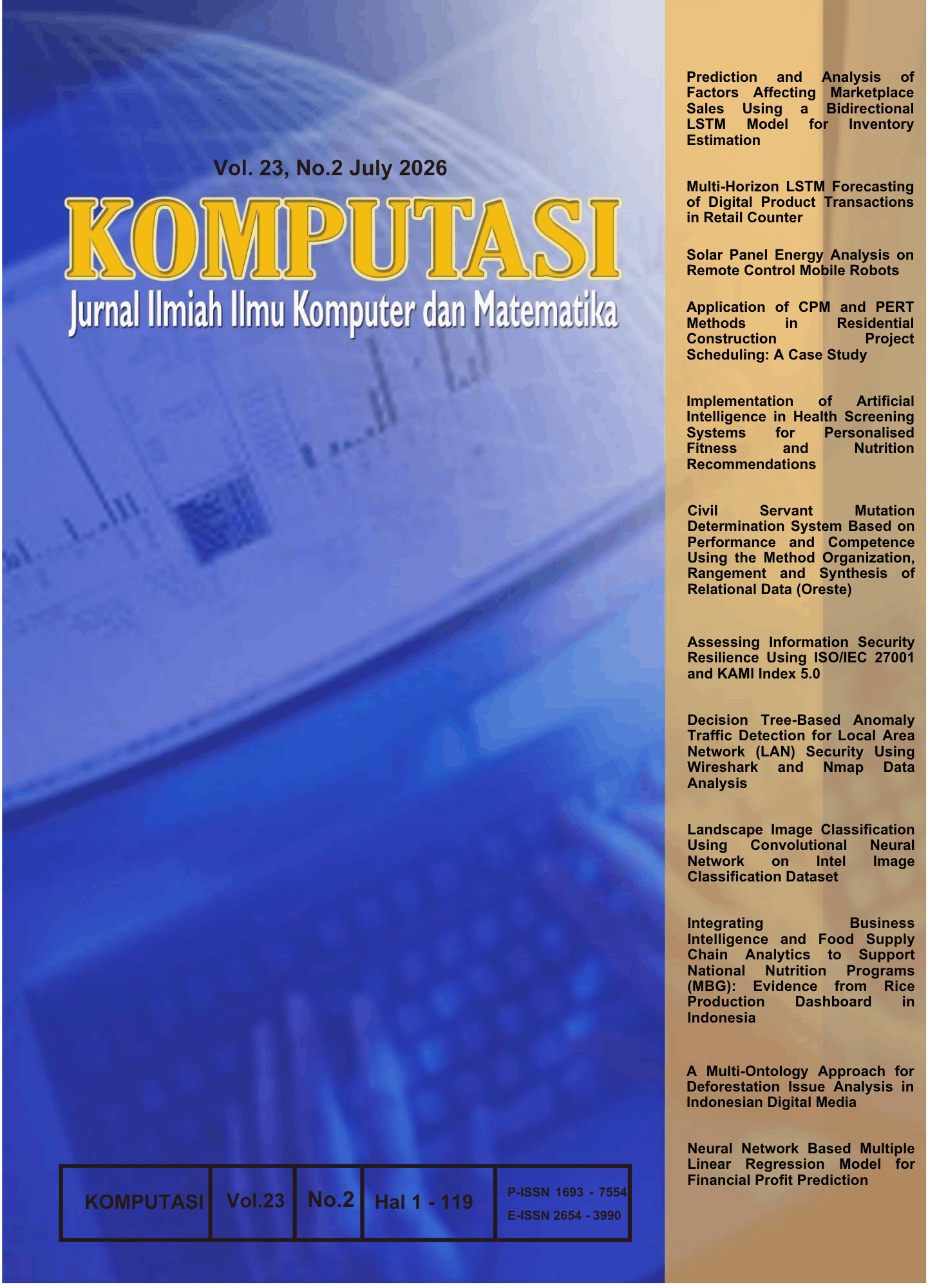
Multi-Horizon Long Short-Term Memory Forecasting of Digital Product Transactions for Retail Counter
DOI:
https://doi.org/10.33751/komputasi.v23i2.98Abstrak
In practice, maintaining optimal balance stock at digital product retail counters is challenging due to highly fluctuating and intermittent daily transaction volumes. Consequently, operators frequently rely on subjective judgment, resulting in inaccurate balance allocation decisions. This study addresses this problem by proposing a data-driven forecasting approach centered on a multi-horizon Long Short-Term Memory (LSTM) model to predict daily digital product transactions and support systematic balance planning. Transaction data were collected from MyFastbiller Telegram chatbot logs, covering 739 days with 27,540 valid transaction records transformed into a structured daily time series. Data preparation involved temporal feature engineering, normalization, and 60-day input sequence generation. A two-layer LSTM model was trained for H-1, H-7, and H-30 forecasting horizons and evaluated using RMSE, MAE, and MAPE against standard baseline models (Moving Average, Naive Forecast, Random Forest, and ARIMA). Results demonstrate consistent accuracy, with the LSTM model achieving MAPE values of 15.24% for H-1, 15.14% for H-7, and 16.35% for H-30 all remaining comfortably below the 20% operational tolerance limit and outperforming the baseline methods, particularly on the long-term H-30 horizon. The H-7 horizon achieved the highest precision due to strong weekly seasonality. The primary novelty of this research lies in tailoring multi-horizon LSTM forecasting specifically to real-world intermittent digital retail transactions and deploying the trained model into a web-based operational dashboard for interactive decision support. Overall, the findings confirm that multi-horizon LSTM forecasting provides an accurate and practical foundation for data-driven balance management in small-scale digital retail counters.
Unduhan
Diterbitkan
Cara Mengutip
Terbitan
Bagian
Lisensi
Hak Cipta (c) 2026 Komputasi: Jurnal Ilmiah Ilmu Komputer dan Matematika

Artikel ini berlisensiCreative Commons Attribution-NonCommercial-ShareAlike 4.0 International License.